Decarbonization workstream

Accelerating Decarbonization Across
the Hospitality Supply Chain

Our Carbon Strategy Direction

As leaders in the hospitality industry, the members of the Hospitality Alliance for Responsible Procurement (HARP) recognize that decarbonizing our value chain is a global and business-critical imperative. Our vision is to accelerate positive impact by collaborating as an industry and to consider best practices that may be adopted by value chain partners.
We are leveraging a carbon maturity framework, powered by EcoVadis, to provide a tool for individual members to independently measure progress and unilaterally drive targeted improvements within their own unique supplier base. Our immediate focus is on each member starting the conversation and mobilizing suppliers for them to establish a strong, measurable baseline for action.

We aim to:

  • Simplify the decarbonization journey for our suppliers.
  • Amplify the industry’s impact in reducing Scope 3 emissions.
  • Demonstrate collective leadership in building a more sustainable future.

The EcoVadis Carbon Maturity Framework

The Carbon maturity levels range from Insufficient/Foundational, Beginner, Intermediate, Advanced, to Leader*.
These levels are determined based on a holistic assessment of a company’s carbon management program, including Commitment, Actions, and Reporting pillars.
The scoring is adaptive and tailored to company size and context, meaning suppliers are assessed on relevant practices rather than a fixed checklist.
The final maturity level is a weighted aggregate of scores from the three indicators: Commitment (25%), Actions (25%), and Reporting (50%).

Here is a description of each maturity level :

Maturity Level

Commitment

Foundational/
Insufficient

Company with minimal or no GHG management system.

Beginner

Company with some elements of a GHG management system and/or reporting practice.

Intermediate

Company with core elements of a GHG management system.

Advanced

Company with comprehensive GHG management system, approved SBT & 3rd party verification.

Prerequisite include :
– Public Reporting or CDP Report
– 3rd party verification

Leader

Company with best in class GHG management system, and formal GHG emissions reduction target,

Prerequisite include :
– Scope 1 + 2 targets
- SBTi target or commitment
– Public reporting / CDP report
– 3rd party verification

Supplier Decarbonization Journey: Calls to Action

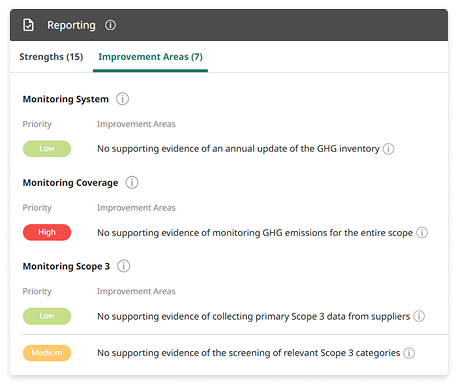
Due to the EcoVadis methodology being adaptive and tailored to company size and context, each supplier has customized Improvement Areas with priority levels that can be worked on. The Improvement Areas issued in the scorecard correspond to missing or insufficient practices, such as :

  • Lack of SBTi-approved targets.
  • Absence of time-bound action plans.
  • No third-party verification.
  • Insufficient supplier engagement.

Improvement Area Examples : 
Here is an example of how a scorecard would showcase some Improvement Areas.

Keeping in mind that Improvement Areas are customized per supplier, here are some examples per maturity level** :

Example Improvement Area

Maturity Level

Commitment

Action

Reporting

Foundational/
Insufficient

  • No supporting evidence on absolute Scope 1 emissions reduction targets
  • No supporting evidence on absolute Scope 2 emissions reduction targets
  • No supporting evidence on absolute Scope 3 emissions reduction targets
  • No supporting evidence of actions regarding energy consumption and GHGs
  • No supporting evidence of reporting on the total gross Scope 1 GHG emissions
  • No supporting evidence of reporting on the total gross Scope 2 GHG emissions

Beginner

  • No supporting evidence on absolute Scope 1 emissions reduction targets
  • No supporting evidence on absolute Scope 2 emissions reduction targets
  • No supporting evidence on absolute Scope 3 emissions reduction targets
  • No supporting evidence of actions regarding energy consumption and GHGs
  • No supporting evidence of reporting on the total gross Scope 1 GHG emissions
  • No supporting evidence of reporting on the total gross Scope 2 GHG emissions

Intermediate

  • No supporting evidence on absolute Scope 3 emissions reduction targets
  • No supporting evidence of a dedicated management team for GHG emissions reduction
  • No supporting evidence of third-party verification of GHG emissions reporting
  • No supporting evidence of product-level GHG data accounting aligned with GHG accounting standards
  • No supporting evidence of the screening of relevant Scope 3 categories

Advanced

  • No supporting evidence of a time-bound GHG emissions reduction action plan
  • No supporting evidence of supplier engagement in climate action
  • No supporting evidence of periodic evaluations of progress towards GHG emissions reduction targets
  • No supporting evidence of collecting primary Scope 3 data from suppliers

Leader

  • No supporting evidence of a time-bound action plan to transform into a low-carbon business model
  • No supporting evidence of partnerships with suppliers to achieve GHG emissions reduction

* Do note that Improvement Areas are customized per supplier and the ones mentioned above may not be reflective to each supplier. There will be suppliers in specific maturity levels that will or will not have listed improvement areas active for that reason.

EcoVadis carbon methodology is customized per supplier and not a one-size fits all approach. Each supplier’s carbon maturity level is rated in a holistic approach. This is why we do not recommend engaging your suppliers to complete a specific improvement area when they are at a specific maturity level. (example – if you are a Beginner supplier, please make sure to provide evidence of monitoring GHG emissions for the entire scope.) Some suppliers may already have these specific areas completed or it may not be their priority improvement area. Our recommendation is to guide them to independently have a better look at their scorecard to understand their strengths
and improvement areas, and to utilize the resources below to tackle them.


Key Resources to Support Supplier’s Progress:

Step 1: Start Here to Understand the Fundamentals

  1. Beginner EV Academy Courses: (platform login required and access subject to the supplier’s subscription plan)
  2. Intermediate EV Academy Courses:  (platform login required and access subject to the supplier’s subscription plan)

Step 2: Utilize Free Tools to Support Your Calculation of Scope 1,2,3

The Carbon Estimator is an easy-to-use tool designed to help your company estimate its greenhouse gas (GHG) emissions with minimal data input requirements. This tool simplifies the process of estimating GHG emissions, making it accessible for companies at all stages of their decarbonization journey, and is particularly beneficial for small and medium-sized enterprises (SMEs) with limited carbon knowledge and resources. If your suppliers have not yet calculated their GHG emissions, they are able to utilize this free tool.

  1. Carbon Estimator (accessible within the Supplier’s platform)
  2. Help Guides for the Carbon Estimator

Step 3: Go Further and Calculate your Product Carbon Footprint

The EcoVadis PCF Calculator is a user-friendly, guided tool designed for our partners to measure their Product Carbon Footprint (PCF). It aligns with the Greenhouse Gas Protocol Product Life Cycle Accounting and Reporting Standard (GHGP-P), ensuring that the emissions data generated is accurate and compliant with leading industry standards. It’s a bottom-up, product-level approach that tracks emissions tied directly to materials, energy consumption, and transportation for each product. While a full Life Cycle Assessment (LCA) covers many environmental impacts, our PCF Calculator focuses specifically on the climate change impact, measured as Global Warming Potential over 100 years (GWP100) using the IPCC 2021 methodology. This allows businesses to understand the climate impact of their products at selected stages of the value chain, within the broader context of their Corporate Carbon Footprint.

  1. PCF Calculator (accessible within the Supplier’s platform)
  2. Help Guides for the Carbon Estimator

Step 4: Continue to stay up to date with Trends and Updates 
Benefits to Suppliers

Demonstrating Management 
Maturity (PDCA)

The EcoVadis Carbon Rating validates a supplier’s Greenhouse Gas (GHG) management through the Plan-Do-Check-Act (PDCA) framework. It allows suppliers to provide buyers with an independent, third-party verification of their decarbonization journey—moving beyond simple carbon footprinting to showing a robust management system (commitments, actions, and reporting).

Strategic Prioritization 
& Actionable Insights

The rating transforms complex climate data into a clear Carbon Scorecard. This helps suppliers structure year-over-year action plans to focus on high-impact areas, such as renewable energy adoption or energy efficiency, rather than reacting to ad-hoc buyer requests.

Closing the “Primary Data Gap”

With the rollout of the Carbon Estimator and PCF (Product Carbon Footprint) Calculator, suppliers can now calculate and share their emissions data without having to purchase additional tools. Being able to provide verified PCF data gives suppliers a significant competitive edge, as buyers increasingly require granular data to meet their own Scope 3 reporting mandates.

Professional Capacity Building

Suppliers gain access to a suite of educational and technical resources through the EcoVadis Academy, Webinars, and the Help Center.

*Note: This framework is an informational tool. Each SI Member maintains independent decision-making authority regarding supplier requirements, terms of supply, and partner selection.
**Note: These are merely examples. Direct members rely on the anonymized, aggregated data presented by the Coordinator or instruct suppliers to address these gaps strictly via their private, individualized Corrective Action Plans (CAP).